Hunting Rivals: Sniper Games
- 4.6
- Rating
- 1.00M
- Installs
- Free
- Price

 Analysis by App-foxy
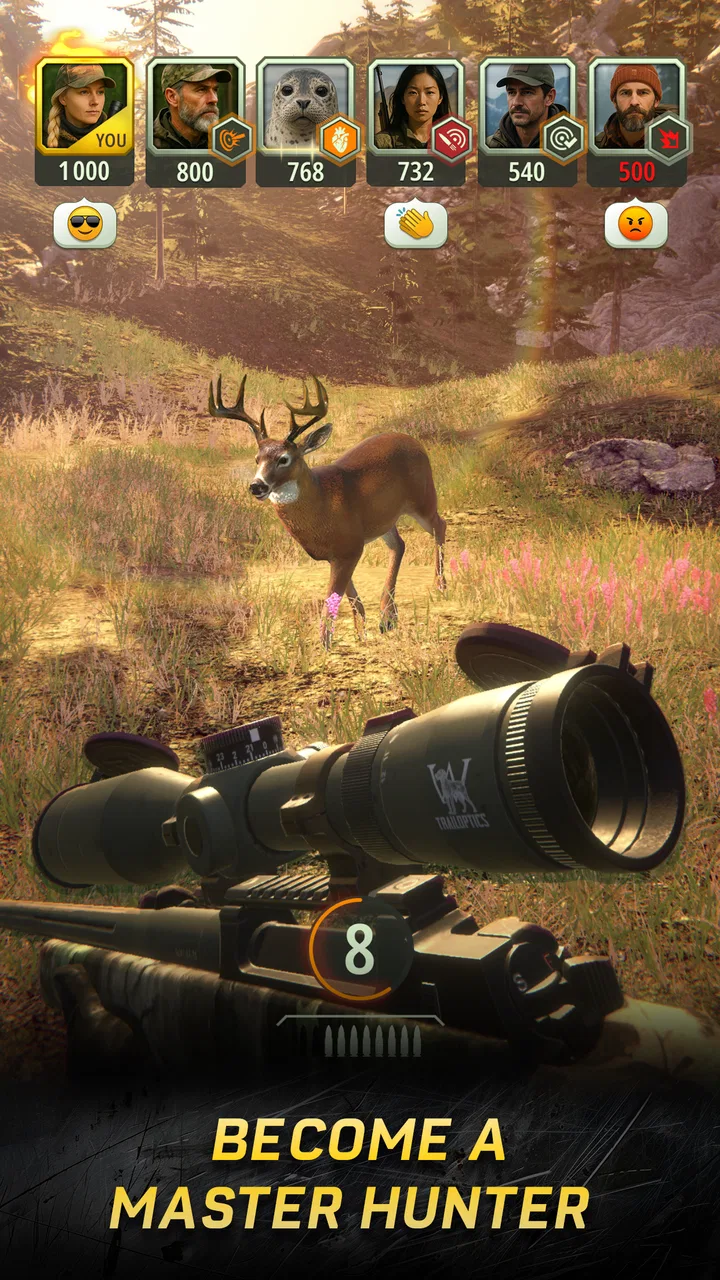
I spent time with Hunting Rivals: Sniper Games to see whether its first impression develops into a game worth returning to, rather than simply delivering a few entertaining sessions and then disappearing from my phone. It is a free simulation game from KEYSTORM HOLDINGS LTD, built around careful shooting, wild-animal encounters, and competition with other players. That combination gives it a more focused identity than a general hunting game, but it also creates expectations: the aiming needs to feel dependable, the progression needs to stay interesting, and the multiplayer side needs to offer more than a short burst of excitement.
My initial reaction was positive because the concept is easy to understand without being completely mindless. You choose a target, line up a shot, and try to make a clean decision before pulling the trigger. The sniper angle makes patience important, while the animal setting gives each encounter a different mood from a standard target-range game. I also liked that the premise works in short sessions. I can play when I have only a few minutes, yet the idea of improving my judgment gives me a reason to continue.
What the first week feels like
The opening appeal comes from the simple tension between speed and accuracy. Shooting immediately may finish an encounter quickly, but taking a moment to assess the situation feels more rewarding. That small pause is where the simulation element matters. I am not just tapping an enemy on screen; I am trying to make a controlled shot while dealing with the pressure of a rival match or a moving opportunity.
You May Also Like

 Blood Strike: 2.5 Anniversary
Blood Strike’s Loadouts Turn Every Drop Into a Tactical Gamble
A close look at Blood Strike’s custom loadouts: how fast access to signature weapons reshapes its battle royale rhythm, rewards preparation, and narrows the gap between fights.

 Pandora - Music & Podcasts
Pandora’s Music Is Easy to Start, but Harder to Recover
Pandora’s strength is its low-effort path from a seed to a station. Its weak spot is how much confidence it asks you to place in connection, setup, and quiet recovery.

 8 Ball Pool
 Is Built on Rivalries, Rematches, and Routine
A close look at the rivalries, rematches, shared routines, and unanswered safety questions that turn a quick pool match into a persistent mobile community.

 Samsung Music
’s Quiet Strength Is Playing What You Already Own
Its reach comes less from spectacle than from dependable access to a personal library. That simplicity is both the app’s strongest retention engine and its ceiling.

 AccuWeather: Weather Radar
AccuWeather Review: A Quick, Clear Forecast for Everyday Decisions
For everyday plans, the best forecast is the one you can understand quickly. AccuWeather makes rain timing, radar, and local conditions easy to act on, with a few trade-offs.

 Hill Climb Racing
Why Hill Climb Racing Still Turns Crashes Into One More Run
A tiny car, a bumpy hill and one more upgrade: Hill Climb Racing keeps resurfacing because its simple chaos makes every near-miss feel personal.
More From Our News Desk



For a new player, this makes the game approachable. You do not need to learn a complicated control scheme before understanding what the game wants from you. At the same time, the straightforward controls leave room for personal discipline. I found that rushed shots were usually less satisfying than deliberate ones, especially when I treated every round as a chance to improve rather than as a race to finish.
The multiplayer focus gives the first sessions extra energy. A solo hunting simulation can become relaxing, but it can also feel predictable once the basic rhythm is familiar. Competition changes the emotional tone. Even when the actual action is brief, knowing that another player is part of the match encourages me to pay attention to timing and accuracy instead of casually firing at anything on screen.
That competitive layer is also the first place where expectations should be realistic. This is not the right choice if you want a deep hunting documentary with extensive wildlife behavior, long expeditions, or a highly detailed outdoor survival loop. Its appeal is closer to a focused shooting contest presented through a hunting theme. I would recommend it to someone who wants quick, skill-oriented rounds, not to someone looking for a slow open-world nature experience.
Small habits that improve the opening sessions
One useful habit is to treat the first week as practice in restraint. Instead of chasing every available shot, I tried to identify what caused a miss: poor timing, an impatient tap, or a failure to settle the aim. That approach made the game feel less dependent on luck. It also helped me notice that the most valuable improvement may not be a faster reaction, but a more consistent routine before each shot.
I also suggest playing with a stable grip and avoiding unnecessary movement while aiming. That sounds obvious, but short mobile games often encourage hurried inputs because the rounds are compact. Here, the compact format can work against you if you turn every encounter into a reflex test. A calm setup makes the sniper theme more convincing and gives the player a clearer sense of control.
Another practical tip is to separate entertainment sessions from improvement sessions. In one session, I may simply play a few rounds for a break. In another, I focus on whether I am making the same mistake repeatedly. This distinction matters because a competitive game can feel frustrating when every loss is interpreted as evidence that the system is unfair. Looking for patterns in my own play made the experience more useful and less emotional.
The game is rated Teen, which fits the hunting and shooting subject matter. Parents should still consider whether competitive firearm-focused gameplay is suitable for the player, even though the setting is built around animals rather than military combat. For older players, the rating gives a reasonable indication that this is not designed as a child-oriented casual game.
Why it may or may not survive the novelty period
The first month is where I think the game has to prove itself. A striking premise can carry a player through the first few days, but recurring value depends on whether each match still offers a meaningful decision. Hunting Rivals has a good foundation because accuracy and timing can remain satisfying after the basic controls become familiar. The question is whether the surrounding progression and competition keep those decisions feeling fresh.
Its strongest long-term use case is the player who enjoys repeatable skill practice. If you like games where small improvements matter, the format can settle comfortably into a daily or several-times-a-week routine. A short round can fit into a commute break, a waiting room, or the few minutes before bed. I would not call it a complete replacement for a larger simulation game, but it can work well as a compact competitive habit.
The multiplayer structure is important here. Playing against other people gives the same basic shot more meaning than practicing against a static target. A good result feels earned because it reflects decision-making under pressure. However, players who dislike rankings, repeated contests, or the possibility of losing after a careful attempt may find that the competitive design becomes tiring rather than motivating.
The free entry point also makes experimentation easy. You can try the core loop without committing money first, which is useful because the game’s appeal is quite specific. It is listed as free, while optional in-app purchases range from $0.49 to $99.99 per item. That wide span is worth keeping in mind before spending: I would decide whether the ordinary play loop already feels satisfying, rather than assuming purchases are necessary to make the game enjoyable.
My advice is to set a personal spending boundary before the game becomes part of your routine. In a competitive shooter, it is easy to justify a purchase as a shortcut to better results, then discover that the real issue was inconsistent aim or simple fatigue. If you do spend, treat it as a convenience or a way to support continued play, not as proof that every session will become more rewarding.
What creates lasting value
For me, lasting value comes from three things: a clear shot-making rhythm, enough variation in the encounters to prevent automatic play, and competition that remains fair enough to make improvement feel worthwhile. Hunting Rivals clearly aims at that combination. The animal theme distinguishes it from urban shooter games, while the sniper perspective gives the action a more measured pace.
The game is also easier to return to than a long-form simulation because it does not demand a large block of free time. That is a genuine strength. Many mobile games lose their place in my routine because I cannot begin a meaningful activity without planning around it. This one is better suited to small gaps in the day, provided I am in the mood for focused competition rather than relaxation.
Still, short sessions can become repetitive faster than long ones if the decisions do not continue to develop. The same convenience that makes the game accessible can make it feel disposable. I would keep it installed if I enjoyed the process of refining my aim, but I would probably remove it if I found myself playing only to collect routine rewards or complete matches without paying attention.
The current version is 1.1.5, and the game was released on January 20, 2026. Those details place it in an early stage of its life, so I would judge it as a developing competitive game rather than a finished, years-old ecosystem. That can be appealing for players who like watching a title grow, but it also means long-term confidence should come from the present gameplay, not from assumptions about future additions.
Maintenance, friction, and reasons to take a break
The maintenance burden is not mainly about complicated controls. It is about keeping your interest alive. A game built around repeated shots needs enough variation in targets, situations, and competitive pressure to avoid turning into a mechanical checklist. If I stop making decisions and simply tap through familiar patterns, the hunting theme loses much of its effect.
There is also a mental maintenance cost. Competitive shooting can encourage one-more-round behavior, especially after a narrow loss. That can be enjoyable when I am alert, but it is a poor fit when I am tired or already irritated. I found that sessions were better when I stopped after a clear improvement or a satisfying match instead of continuing until I was trying to recover a result.
Device compatibility is reasonably broad: the game supports Android 9 and later. That helps players using older phones, although support for an operating system does not guarantee identical performance on every device. For a game where timing and aiming matter, a smooth, responsive experience is more important than simply being able to install it. I would test it during a calm session before deciding whether it belongs in a serious competitive rotation.
The rating numbers suggest that the game has already attracted a substantial audience, with a 4.6 average from around 15 thousand ratings and more than a million installs. I see that as a useful sign of initial appeal, not as a guarantee that it will suit every player. Ratings often reflect the excitement of discovery, while long-term retention depends on personal tolerance for repetition and competition.
The review volume, at around 428 reviews, also gives prospective players some context about the breadth of public feedback. I would still focus on whether the core loop matches your preferences. A high average cannot turn a competitive hunting game into a peaceful wildlife simulator, and a player who dislikes in-app purchases may have a different experience from someone comfortable with optional spending.
Who should skip it
I would skip this game if your main goal is to observe animals, explore large natural environments, or build a detailed hunting career at a slow pace. The sniper-and-rival format is more concentrated and contest-driven. It is also not ideal if you want a game that can be played almost entirely passively. The best moments depend on attention, and careless play removes much of the satisfaction.
I would be cautious if you are especially sensitive to monetization pressure. The free download lowers the barrier to entry, but the presence of purchases up to $99.99 per item means spending discipline matters. Even without assuming that purchases are required, I would not recommend starting this game to someone who regularly feels compelled to buy advantages or accelerators in competitive titles.
It may also be a poor fit for players who need a strong narrative reason to keep playing. The appeal here comes from the act of aiming, judging, and competing. If you need characters, story chapters, or a large world to explore, another simulation or action game will probably provide more lasting motivation.
Who will get the most from it
I think it suits players who want a compact mobile game with a clear objective and a little pressure. It is especially appropriate for someone who enjoys improving through repetition but does not want to spend an hour preparing for a session. The hunting theme adds atmosphere without requiring the commitment of a full-scale outdoor simulator, and the multiplayer element gives ordinary rounds a reason to matter.
A realistic everyday scenario would be a short break after work. I might play a few matches while waiting for dinner, focusing on controlled shots rather than trying to complete a long activity. If the session goes well, I leave with the feeling that I practiced something specific. If I lose repeatedly, the short format makes it easy to stop before frustration turns the break into another obligation.
The game can also work for friends who enjoy comparing results informally, but I would not install it solely because someone else likes competitive shooters. The personal test is simple: does the act of lining up a shot remain enjoyable after the novelty of the animal setting fades? If yes, the game has a chance to become a regular companion. If not, its presentation will not carry it for long.
Compared with a traditional hunting simulator, this is more immediate and less demanding. Compared with a standard sniper game, it offers a less conventional wildlife setting and a more patient tone. Compared with a relaxed casual game, it asks for more concentration and exposes you to competitive pressure. That middle position is its identity, but it also explains why it will not replace every alternative.
My long-term verdict
After looking beyond the first impression, I see Hunting Rivals as a focused simulation game with a credible place in a mobile library, provided its particular rhythm suits you. Its best quality is the way it turns a simple shot into a small decision about patience, timing, and accuracy. The free starting point makes it easy to test, and the short-session design is genuinely convenient for everyday play.
Its weaknesses are equally clear. Repetition can become noticeable if the encounters stop demanding thought, and multiplayer competition can change from motivating to exhausting. The in-app purchase range means I would approach spending carefully, especially if results begin to feel tied to purchases rather than practice. Those are not reasons to dismiss the game, but they are reasons to treat it as a specialized hobby rather than an automatic recommendation.
For me, the deciding factor is maintenance of interest. I would keep it installed during periods when I want a quick accuracy challenge and can enjoy gradual improvement. I would take a break when matches become routine, when I start playing only to recover losses, or when the purchase system distracts from the shooting itself. That flexible relationship feels healthier than forcing it into a daily habit.
My recommendation is to try it as a short-session competitive hunting game, not as a complete wildlife simulator. If you enjoy measured sniper play, brief multiplayer contests, and the satisfaction of becoming more consistent, it can earn recurring space after the initial novelty fades. If you want exploration, story, or a generous offline-style experience with little pressure, I would choose a different game. Hunting Rivals is at its best when you approach it for the shot itself—and know when to put the rifle down.
FAQs for Hunting Rivals: Sniper Games
01What is Hunting Rivals: Sniper Games?
Hunting Rivals: Sniper Games is a mobile hunting and shooting game focused on precision, timing, and target tracking. Players use different sniper-style weapons to hunt animals across various environments, completing missions and improving their equipment. The game is designed for short sessions, making it suitable for casual players, although later challenges require more patience and accurate aiming.
02How does the gameplay work in Hunting Rivals: Sniper Games?
The main gameplay revolves around entering hunting missions, locating the assigned target, aiming carefully, and taking the shot at the right moment. Wind, distance, movement, and target behavior can affect your success depending on the mission. Completing objectives usually rewards you with coins, upgrades, or access to additional content, encouraging gradual progression through increasingly difficult stages.
03Is Hunting Rivals: Sniper Games free to download and play?
Hunting Rivals: Sniper Games can generally be downloaded and played without an initial purchase, but players should expect optional in-app purchases and possible advertising. These may provide extra currency, equipment, bonuses, or faster progression. You can enjoy the basic experience without spending money, although free players may need to tolerate advertisements and wait longer to obtain certain upgrades.
04Does the game require an internet connection?
An internet connection may be needed for advertisements, account-related features, updates, rewards, and other online services. Some missions might remain accessible when you are offline, but this can vary according to the version installed and the device being used. It is best to launch the game while connected before traveling or playing in an area with limited mobile data.
05Is Hunting Rivals: Sniper Games suitable for children?
The game may be easy to understand because its controls and objectives are straightforward, but it includes hunting themes, firearms, and animal shooting. Parents should review the age rating and the content shown in the current store listing before allowing children to play. They should also check in-app purchase settings, advertising content, and whether the game matches their family’s preferences.
Pros
- Responsive sniper controls make aiming feel precise and satisfying.
- Multiple hunting environments provide visual variety during missions.
- Short levels suit quick gaming sessions on mobile devices.
- Weapon upgrades add a clear sense of progression.
- Offline play may be convenient when no internet connection is available.
Cons
- Some missions can feel repetitive after extended play.
- Later upgrades may require considerable grinding or in-game spending.
- Animal movement patterns are sometimes predictable.
- The game may consume noticeable battery during longer sessions.
- Ads can interrupt the experience
- especially between missions.

Hunting Rivals: Sniper Games
Gallery